


Lyrics and chords of Mia Martini available on FaDiesis
More about Mia Martini
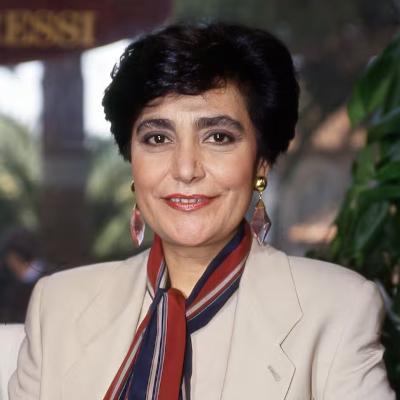
Domenica Rita Adriana "Mimì" Bertè (Italian pronunciation: [doˈmeːnika (miˈmi b)berˈtɛ]; 20 September 1947 – 12 May 1995), known professionally as Mia Martini (pronounced [ˈmiːa marˈtiːni]), was an Italian singer, songwriter and musician. She is considered, by many experts, one of the most important and expressive female voices of Italian music, characterised by her interpretative intensity and her soulful performance.
Her debut album, Oltre la collina with the song "Padre davvero" is regarded as one of the best Italian albums made by a female artist. Hit songs like "Piccolo uomo", "Donna sola", "Minuetto", "Inno", "Al mondo", "Che vuoi che sia se t'ho aspettato tanto", "Per amarti" and "La costruzione di un amore" made her one of the most popular artists of Italian music in the 1970s, both nationally and internationally. She is the only female artist to have won two Festivalbar consecutively, respectively in 1972 and in 1973. In 1977, two important encounters occurred in Martini's life: the first with Charles Aznavour, with whom she began a musical collaboration, and the second with singer-songwriter Ivano Fossati, with whom she started an artistic and sentimental partnership.
In 1982, she sang "E non finisce mica il cielo", written by Fossati, at the Sanremo Music Festival, where she received the Critics Award, which was created specifically for her interpretation and which was named after her as "Mia Martini" Critics Awards from 1996, the year after her death. In 1983, she was forced to leave the music industry and quit her career, as the music sector and colleagues considered her a person bringing bad luck and barred her from participating in any music and TV events, radio shows and concerts. This kept her away from the music scene for seven years. Only in 1989 was she able to reprise her career, when she returned to perform at the Sanremo Music Festival, singing "Almeno tu nell'universo", which brought her a new success.
Martini's later hits included "Gli uomini non cambiano", "La nevicata del '56" and "Cu' mme", the latter with Roberto Murolo. She represented Italy at the Eurovision Song Contest twice, in 1977 with the song "Libera" and in 1992 with "Rapsodia". She died from a drug overdose on 12 May 1995.
| The scores for this artist on FaDiesis are: 4 | |
|---|---|
| Title of the song | |
| Almeno tu nell'universo |

|
| Donna |
|
| Gli uomini non cambiano |
|
| Minuetto |
|
